
UseJunction

See every AI coding tool your team uses — before you try to control it

Models, cost, and device health across your org. Self-hosted and open source.

Overview/last 24h
live·0
Requests / 24h
12,847
Est. cost
$284.50
Avg latency
1.2s
Error rate
0.8%
DeveloperCursorCursorClaude CodeClaude CodeGithubCopilotCopilotOllamaOllama
sarah@acme.dev
Platform
$48.201.2M tok890ms
alex@acme.dev
Backend
$36.10840K tok1.1s
morgan@acme.dev
Infra
personal key detected
$29.80620K tok1.4s
jordan@acme.dev
Mobile
$18.40410K tok760ms2 models
taylor@acme.dev
Data
$12.10280K tok2.1srunning

Supported tools & runtimes

Codex
Codex
Claude Code
Claude Code
Cursor
Cursor
Continue
Cline
Cline
RooCode
Roo Code
opencode
OpenCode
GithubCopilot
GitHub Copilot
Ollama
Ollama
LM Studio
LM Studio

The problem

Your team already runs a dozen AI coding tools. Your organization cannot see any of it.

Developers pick Cursor, Claude Code, Copilot, or local Ollama models on their own machines. Engineering leaders have no org-wide view of adoption, spend, latency, or misconfiguration. Finance sees surprise invoices. Security cannot tell personal keys from company keys.

What you can see

Observability answers for engineering, finance, and security

The MVP delivers the foundation: who uses what, what it costs, how it performs, and whether devices are configured correctly.

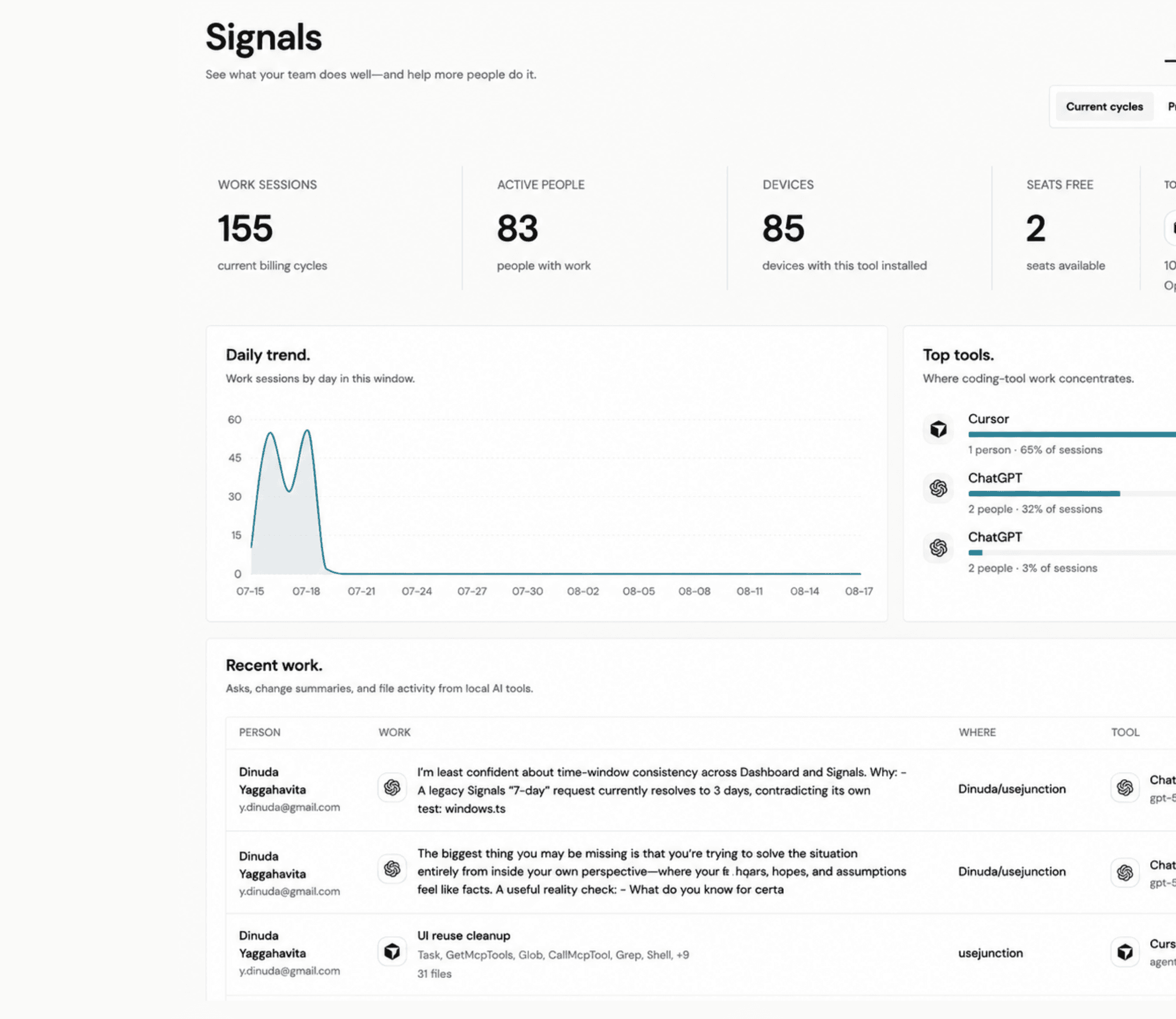
24 active devs

Who is using AI coding tools

Per-developer adoption across your org — active users, last seen, and coverage gaps.

8 tools tracked

Which tools & models

Tool installations and model calls broken down by user, team, and device.

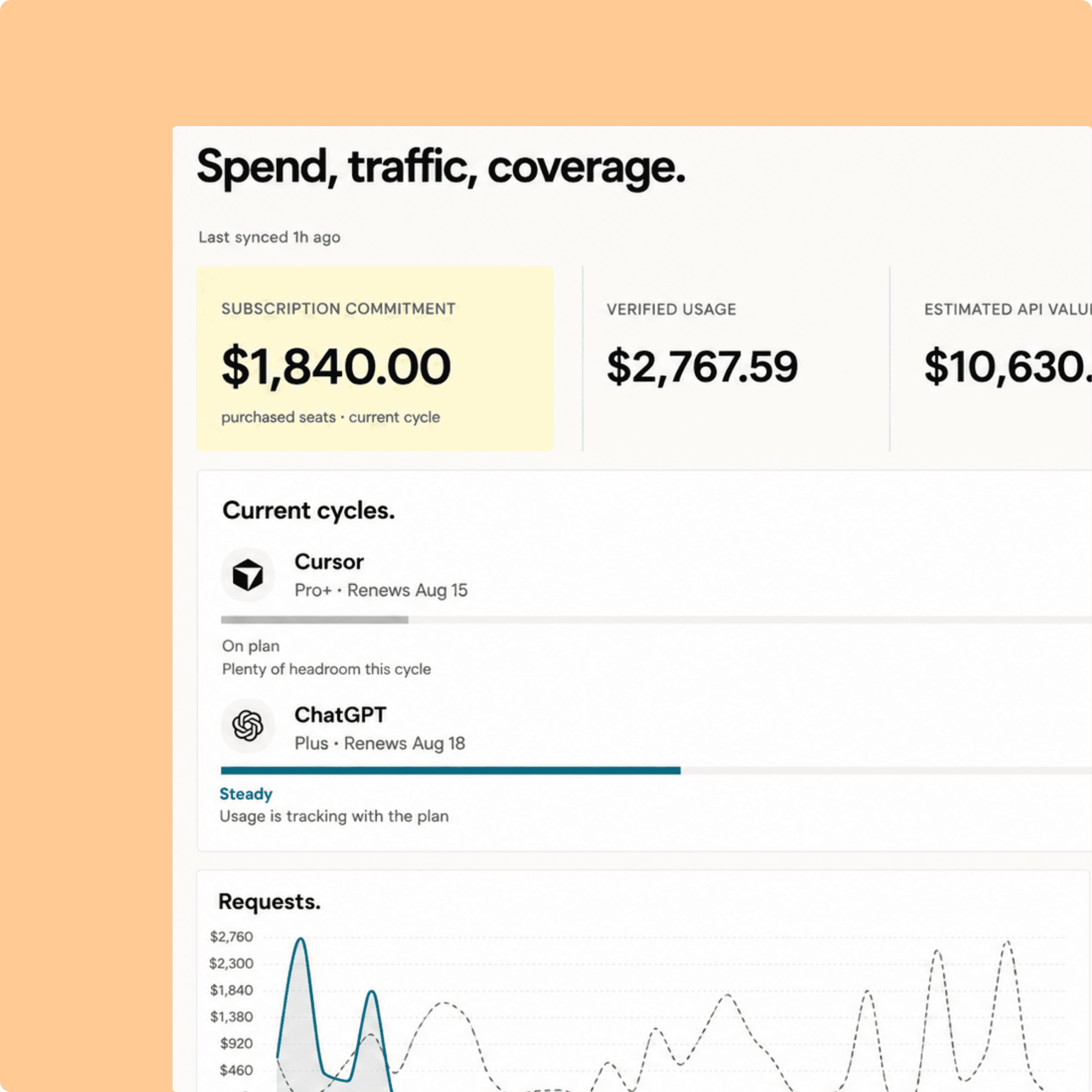
$284.50 / 24h

Cost by user / tool / model

Estimated spend attribution so finance and eng leads see where money goes.

1.2s avg · 0.8% err

Latency & failure rate

Per-model response times and error rates to spot degraded providers early.

31/33 online

Device configuration health

Agent heartbeats, config drift, and unhealthy device flags in one view.

3 personal keys

Personal vs company keys

Detect when developers use personal API keys instead of org-provisioned ones.

12 local runtimes

Local models on devices

See which developers run Ollama, LM Studio, or other local inference.

12,847 req / 24h

Request activity log

Inspect individual requests with model, tokens, latency, and status.

How it works

Four steps to org-wide visibility

Observation requires no change to the developer's workflow. Install, enroll, configure, see.

01

Install the admin app

Deploy the self-hostable UseJunction admin on your infrastructure — Docker Compose, a single VM, or your existing cluster. Your data stays on your network.

02

Roll out the local agent

Developers enroll devices with a single token. The lightweight agent runs locally and reports metadata — no workflow changes required.

03

Configure supported tools

Point Cursor, Claude Code, Continue, and other supported tools at the agent. Observation only — no traffic interception.

04

See usage in the dashboard

Cost, models, latency, device health, and key usage appear in one org-wide view. Visibility before control.

Open source

Your data never leaves your infrastructure

UseJunction is open source under the MIT license. Self-host on a single machine, Docker Compose, or your own cloud — no vendor SaaS holding your usage data.

Star on GitHubMIT · Self-hostable

Pricing

Simple, transparent pricing

Open source and self-hosted. No hidden fees — your data stays on your infrastructure.

Community

Perfect for side projects and small teams

$0

per month

Get Started
  • Self-hosted MIT license
  • Up to 25 enrolled devices
  • Usage & cost dashboard
  • Tool & model visibility
  • Community support on GitHub
Popular

Team

For growing teams that need more power

$0

per month

Get Started
  • Everything in Community
  • Unlimited enrolled devices
  • Per-developer cost attribution
  • Latency & error rate metrics
  • Personal key detection
  • Device configuration health
  • Team API keys (roadmap)
  • Multi-team rollup (roadmap)
  • Policy controls (roadmap)

Enterprise

For organizations that need full control

Custom

contact us

Contact Sales
  • Everything in Team
  • Dedicated onboarding
  • Custom retention policies
  • Deployment assistance
  • Priority support channel
  • SSO & SAML (roadmap)
  • Audit log export
  • SLA guarantee

Where this is going

Visibility today. Control next.

Once your organization can see AI coding usage, UseJunction becomes the layer where teams introduce team API keys, adopt local models, and eventually add routing, policy, and cost optimization. Roadmap — not available today.

Incoming requests

request · long-contextpolicy
idle·~4,615 req/h

UseJunction · router

routing by cost · latency · policy

Routed to

Claude Code

Claude Sonnet

Anthropic

policy: sensitive1.1s · $0.012/k
OpenAI

GPT-4o

OpenAI

latency: fast0.9s · $0.005/k
Ollama

Ollama

local

cost: $0self-hosted
GithubCopilot

Copilot

GitHub

fallback2.1s · seat

Route requests to the right model based on cost, latency, and policy — when you're ready.

Roadmap — not available today
Roadmap

Team API keys

Introduce org-provisioned keys once usage data shows where personal keys hide.

Roadmap

Local & self-hosted models

Help teams adopt Ollama and open-weight models with visibility into local usage.

Roadmap

Policy & cost optimization

Enforce budgets and model policies on top of the observability foundation you already trust.

Start with visibility. Grow into control.

Deploy the open-source admin app, roll out the agent, and see what your team actually uses.